

The blue collar workforce powers the economy.
Table of Contents
- Labor Trend Among Businesses of All Sizes
- Top Job Roles that Form a Skeleton Crew
- Potential Benefits of a Skeleton Crew
- Potential Risks of Running a Skeleton Crew
- Would Keeping a ‘Skeleton Crew’ Work for Logistics and Manufacturing Companies
- Successful companies view skeleton crews as one tool in a broader operational toolkit
Labor Trend Among Businesses of All Sizes: ‘Skeleton Crews’
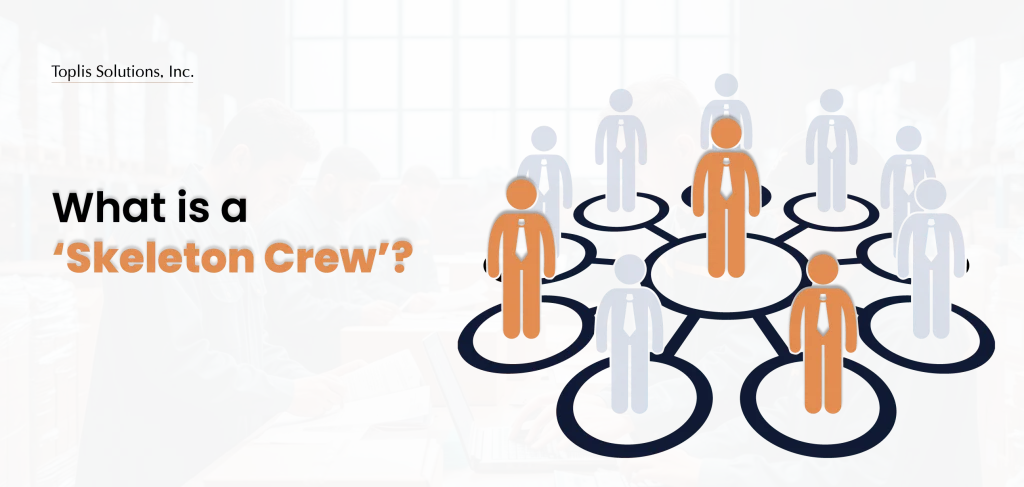
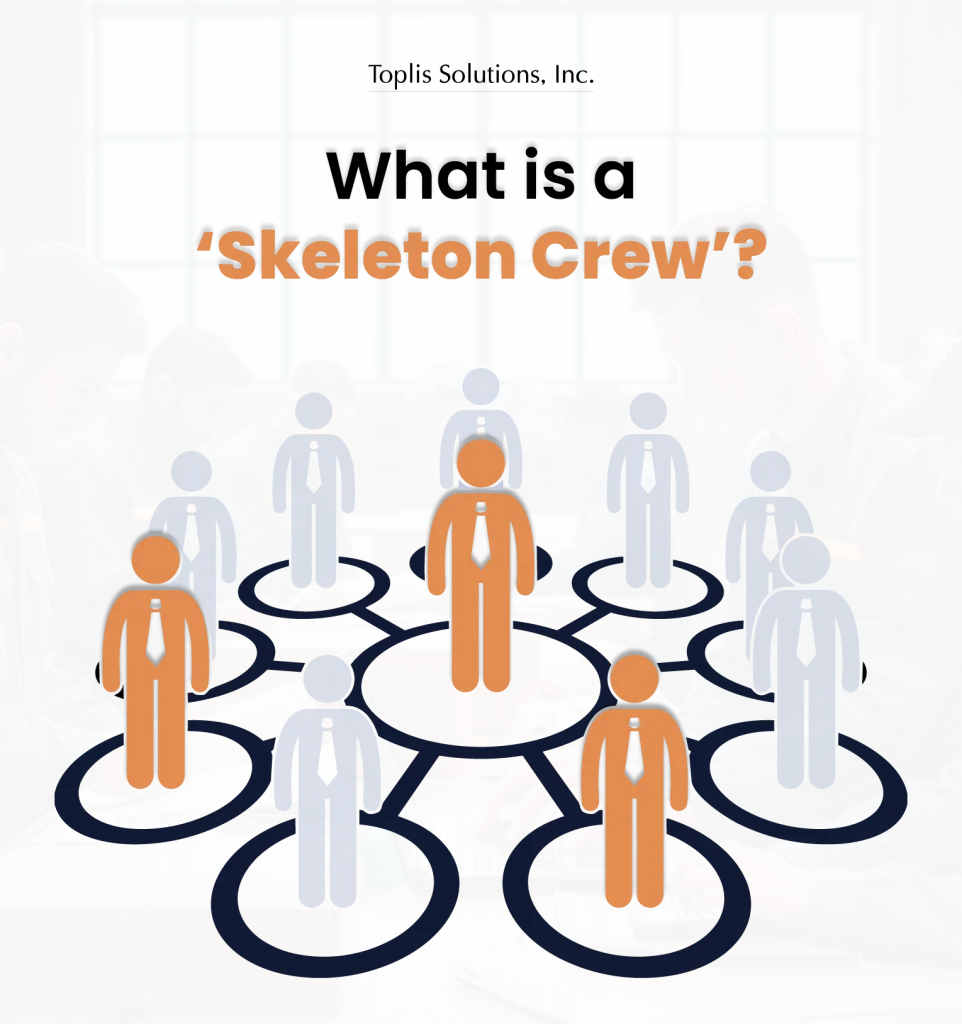
What is a ‘Skeleton Crew’?
A skeleton crew refers to the minimum number of employees needed to keep your operations going. It means keeping only the most essential workers, without the need for extra support. For example, a small team of three people (a manager, a cashier, and a sales attendant) running a retail store during Christmas season.
Did You Know:
The term ‘skeleton crew’ actually originated as a nautical term. It is an 18th/early 19th century maritime terminology that implies a ‘bare bones’ structure, wherein only the most necessary parts are kept for functionality.
Understanding the skeleton crew concept is crucial for manufacturing and logistics leaders because it directly impacts operational efficiency, cost management, employee morale, and service continuity.
When implemented strategically, skeleton crews can help companies combat seasonal fluctuations, downturns, or transitional periods while maintaining baseline productivity. However, the decision to operate with minimal staffing requires careful consideration of both short-term needs and long-term sustainability.
Before going over its benefits and risks, let’s first imagine what a skeleton crew would look like in the logistics and manufacturing settings.
Top Job Roles that Form a Skeleton Crew in an Industrial Setting
In logistics and manufacturing environments, a skeleton crew typically consists of key personnel who can maintain essential operations and respond to critical situations.
Here are the primary roles that commonly comprise a skeleton crew:
Maintenance and Safety Personnel
Maintenance and safety personnel respond to mechanical failures and perform preventive maintenance checks. However, in a skeletal crew, maintenance staff are on-call most of the time rather than present full-time. But it should be noted that their availability is critical to prevent extended downtime from equipment failures.
Supervisors or Plant Managers
Leadership presence is crucial even with minimal staffing. Supervisors provide the oversight, make final decisions, and serve as the primary point of contact for escalations (should there be any). Plant managers monitor operations and authorize necessary adjustments to workflows.
Quality Control Specialists
Maintaining quality standards is a non-negotiable even with reduced manpower. Quality control personnel conduct inspections, test products, document compliance requirements, and ensure that output meets specifications. Their presence prevents costly recalls or customer complaints that could arise from quality lapses during skeleton crew periods.
Site Coordinators
In logistics settings, coordinators manage incoming shipments, outbound deliveries, inventory tracking, and communication with drivers. They ensure that any shipping or receiving issues are addressed promptly.
Core Machine Operators
These skilled workers run essential production equipment and machinery. They possess the technical knowledge to operate, perform, and maintain production flow at a reduced capacity.
Now that we know the basic roles in a skeleton crew for the logistics and manufacturing industries, let’s examine whether keeping manpower to a minimum is beneficial or risky for businesses in these sectors.
Potential Benefits of a Skeleton Crew
Running a business with a limited number of headcount offers several strategies benefits. This is specially true for businesses that are small or just starting. But that doesn’t mean that big businesses don’t utilize this workforce framework either.
Government agencies in the Philippines like the Bureau of Customs adapts this skeleton workforce during emergencies to ensure continuity in its operations. A university in Bicol combines this framework with a work-from-home setup for maximum operations.
When implemented properly, a skeleton crew can help with cost management, operational flexibility, resource optimization, and peak recovery.
Significant Cost Management
Rising costs force businesses to cut jobs, reduce staff, and merge units to manage their budget. This has come to be a necessity because labor is represented as one of the largest operational expenses. By keeping only essential personnel, companies can achieve substantial savings on wages, associated payroll costs, and control foot traffic on site.
Operational Flexibility
Skeleton crews provide companies with the agility to scale operations up or down based on actual demand. This flexibility allows businesses to respond more efficiently to market fluctuations or changes without the financial burden of carrying excess labor capacity.
Resource Optimization
Operating with minimal staff forces companies to identify and prioritize truly essential activities. This often reveals inefficiencies in normal operations and can drive process improvements that benefit the company. Teams learn to work more efficiently and eliminate wasteful practices.
Competitive Advantage During Peak Recovery
Companies that maintain skeleton crew operations can ramp up more quickly when demand returns compared to facilities that shut down completely. Equipment stays operational, processes remain familiar to staff, and the learning curve for returning to full capacity is significantly reduced.
Potential Risks of Running a Skeleton Crew
While having a skeleton crew can bring significant advantages to your business, it also poses potential risks that you might face if implemented without careful consideration:
High Churn Environment
Personnel working in skeleton crew often face increased workloads, longer hours, and higher stress levels. The pressure of maintaining operations with minimal support can lead to drain, decreased job satisfaction, and higher turnover.
Limited Capacity to Handle Disruption
Skeleton crews have minimal buffer to absorb unexpected challenges. A problem that would be manageable with full staffing can escalate into a crisis when only essential personnel are available.
Quality Control Challenges
Maintaining consistent quality standards becomes more difficult when staff are stretched thin. Rushed processes and fatigue-related errors can lead to damage to brand reputation. The cost of poor quality often exceeds the labor savings achieved through skeleton staffing.
Knowledge Loss and Gaps
Extended time away from operations can result in skill degradation. The cost of recruiting and training replacements often exceeds the short-term savings from reduced staffing.

Would Keeping a ‘Skeleton Crew’ Work for Logistics and Manufacturing Companies Long-Term?
Now that we’ve laid out both the advantages and risks of keeping a skeleton crew, let’s move on to settling if it would work for logistics and manufacturing companies.
Short answer: Neither yes or no.
Rather, it depends heavily on how, when, and why you need a skeleton crew in the first place. Deciding on deploying a lean crew requires a nuanced evaluation of your business and a timely implementation approach.
Strategic vs. Chronic Implementation
Skeleton crews can work long-term when used strategically during predictable low-demand periods. However, relying on skeleton crews as a cost-cutting measure to compensate for operational inefficiencies is unsustainable.
Industry-Specific Considerations
Certain logistics and manufacturing operations are better suited for skeleton crew approaches. Here are examples where a skeleton crew would work best:
Highly Automated Facilities
Manufacturing plants with significant automation can maintain production with fewer human operators. However, skilled technicians must still be available for monitoring, maintenance, and troubleshooting.
Warehousing and Distribution with Predictable Patterns
Logistics operations with clear volume forecasts can adjust staffing to match demand cycles, while preparing to scale up for anticipated increases.
Now, here are examples of where a skeleton crew might prove to be problematic if implemented:
Just-in-Time Manufacturing
Operations dependent on immediate response to demand signals cannot afford the reduced flexibility and slower response times that come with minimal staffing
High-Mix, Low-Volume Production
Facilities producing diverse product variations requiring frequent changeovers and specialized knowledge need adequate staffing to maintain efficiency and quality across product lines.
Key Takeaway
In summary, skeleton crews can work particularly for companies with predictable demand fluctuations, significant automation, or clear seasonal patterns. They cannot, however, serve as a permanent solution to fundamental business challenges or replace the need for adequate baseline staffing to maintain safe, quality, efficient operations.
The most successful companies view skeleton crews as one tool in a broader operational toolkit rather than a primary strategy.
For logistics and manufacturing leaders considering skeleton crew approaches, the path forward requires honest assessment of your business. See whether reduced staffing addresses temporary circumstances or attempts to paper over fundamental operational challenges.
The right question is not whether skeleton crews can work long-term. Rather, focus on the when, how, and under what conditions they serve your company’s strategic objectives. Companies that can honestly answer these questions are positioned to use skeleton crews effectively as part of a sustainable operational strategy.
Optimize Your Staffing Strategy
Let’s discuss your challenges and develop a staffing strategy aligned with your business goals
Schedule a Meeting